
“Work becomes worship when it cultivates what is good and protects what God has entrusted to us.”- Dr. Navon Lindo, Jr.
Most people separate their lives into two fields.
There is the sacred field: prayer, worship, church, ministry, and Bible study.
Then there is the ordinary field: meetings, reports, clients, deadlines, budgets, housework, parenting, planning, and problem-solving.
We assume God is deeply interested in the first field and cautiously observing the second.
But Eden tells a different story.
Before there was a church building, there was a garden.
Before there was a worship service, there was an assignment.
Before humanity developed religious programs, God gave Adam meaningful work.
The first human vocation took place inside God’s dwelling place.
That means work and worship were never intended to become enemies.
Adam Was More Than a Gardener
Genesis 2:15 describes Adam’s responsibility to cultivate and keep the Garden. Chapter 1 of my book,
Equipping through the Gates, explains that these two responsibilities
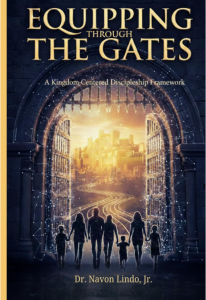
In Equipping Through The Gates, Dr. Navon Lindo, Jr. presents a comprehensive discipleship framework designed to restore humanity’s original purpose through the lens of Kingdom-centered theology. The author utilizes the symbolic Twelve Gates of Jerusalem from the book of Nehemiah and the book of Revelation to outline a progressive developmental path for believers. By moving through these gates, disciples aim to reclaim four essential mandates: Sonship, Priesthood, Rulership, and Ambassadorship. The author emphasizes that true spiritual maturity requires moving beyond denominational boundaries to embrace the power and culture of the Kingdom of God. Ultimately, this model seeks to transform individuals into priest-kings who manifest divine order within every sphere of life, including the marketplace. This biblical roadmap serves as both a theological foundation and a practical coaching tool for modern Christian growth.
communicate priestly service and protective guardianship. Adam was called to serve within sacred space while guarding it against
corruption.
This reveals two movements that should shape our work today:
Cultivate what produces life.
Guard what preserves integrity.
That is the rhythm of worshipful labor.
Work is not sacred simply because a Christian performs it. It becomes sacred when it is offered to God, aligned with His character,
and used to cultivate life while resisting corruption.
Writing a report can become worship when it brings clarity.
Managing a budget can become worship when it demonstrates integrity.
Leading a team can become worship when it develops people rather than using them.
Creating a product can become worship when it genuinely serves.
Correcting a harmful practice can become worship when it guards what is valuable.
The issue is not whether your work takes place in a sanctuary.
The issue is whether you treat your field as sacred territory.
The False Divide Is Costing Us Impact
When believers think only church-related activities matter to God, they unintentionally reduce the reach of the Kingdom.
The teacher underestimates the classroom.
The entrepreneur underestimates the company.
The parent underestimates the home.
The designer underestimates the creative process.
The manager underestimates the meeting.
The technician underestimates the system.
The caregiver underestimates the bedside.
We wait for a ministry opportunity while standing inside an assignment.
This is what many people miss: the Kingdom often advances through work that does not look religious.
It moves when confusion becomes clarity.
It moves when exploitation becomes service.
It moves when dysfunction becomes order.
It moves when fear gives way to courage.
It moves when people use their gifts to create solutions that reflect the wisdom and character of God.
Your workplace does not need religious decoration to become a place of Kingdom impact.
It needs a disciple who understands the priesthood of work.
The Cultivate-and-Keep Framework
Every meaningful assignment contains something you are called to cultivate and something you are called to guard.
Cultivate people
Who is growing because of your influence?
Cultivating people requires more than being pleasant. It means creating conditions in which people can develop, contribute, learn,
and flourish.
A Kingdom Impact-Maker does not merely complete tasks. Kingdom Impact-Maker increases the capacity of the people around them.
Cultivate possibilities
What opportunity is hidden inside the problem in front of you?
Cultivation requires vision. You must be able to see more than what currently exists. The ground may look unproductive, but a
cultivator sees what can emerge with attention, patience, skill, and intentional action.
Guard the culture
What behavior are you permitting that is damaging the environment?
Culture is formed not only by what leaders announce but by what they allow.
Guarding culture means protecting trust, truth, dignity, accountability, and shared purpose.
Guard your inner sanctuary
What is your work producing inside you?
Success is not Kingdom success if gaining influence causes you to lose integrity.
You can build something impressive while becoming someone unhealthy. You can increase revenue while decreasing peace.
You can expand your platform while weakening your character.
A priest does not only tend the external environment. A priest guards the condition of the sanctuary.
Your internal life matters.
Worship Is More Than What You Sing
If worship is reduced to music, most of the week becomes spiritually irrelevant.
But when work is understood as priestly service, Monday is reconnected to Sunday.
The question is no longer, “How quickly can I finish this task?”
The question becomes, “How can this task reflect the King?”
That shift changes execution.
Excellence becomes more than image management. It becomes an offering.
Integrity becomes more than risk avoidance. It becomes guardianship.
Innovation becomes more than competitive advantage. It becomes cultivation.
Service becomes more than customer satisfaction. It becomes an expression of Kingdom culture.
This does not mean every job is healthy or every organizational demand is righteous. It means that wherever God has positioned
you, you can begin discerning what should be cultivated, what must be guarded, and what needs to be transformed.
Your Seven-Day Work Audit
For the next seven days, choose one recurring task and run it through these questions:
- Purpose: Who is served when this task is done well?
- Presence: What quality of God’s character can I reflect while doing it?
- Cultivation: What good result am I helping to grow?
- Guardianship: What value, person, or standard must I protect?
- Excellence: What would faithful execution look like?
- Impact: What becomes better because I completed this work?
- Worship: How can I consciously offer this action to God?
This is not about making work more religious.
It is about making it more intentional.
Your Next Move
Identify one task you normally treat as insignificant.
Before beginning it, pause.
Dedicate it to God.
Name the person it will serve.
Name the value you will guard.
Name the outcome you will cultivate.
Then execute it with excellence.
The field in front of you may look ordinary, but that does not mean it is empty of divine purpose.
You do not need a microphone to minister.
You do not need a church title to serve.
You do not need a religious audience to reflect the King.
Your work can carry worship.
Your leadership can cultivate life.
Your integrity can guard sacred ground.
The question is not whether your work is important enough for God.
The question is whether you can see the assignment hidden inside it.
Kingdom Impact-Maker Reflection
- What has God entrusted to you to cultivate?
- What must you begin guarding more intentionally?
- Which routine task will you transform into worship this week?